

Citation:
Kellogg, S., & Garcia Torres, A. (2026). “I feel like there is a part of me that hates me”: Chairwork psychotherapy and the treatment of the Inner Critic. Chairwork Psychotherapy Initiative.
Abstract
The Inner Critic is an internal voice that can be experienced as demanding, punitive, or hate-filled. In its more extreme forms, it is seen as playing a central role in depression, anxiety disorders, addictions, and personality disorders. Embracing current perspectives in psychotherapy, we argue for a “Two Critics” model—one seeing the Critic as an internalization of social and familial messages (Internalized Abuser) and the other understanding the Critic as developing early in childhood as a strategy for survival (Protector Critic). We believe that both of these perspectives have validity and that Chairwork Psychotherapy can be a highly effective approach for treating both forms of the Inner Critic. The dialogue strategies and methods for doing this are laid out in this paper.
*******
“Inside of each of us is a negative influence that is responsible for 99% of our psychological problems. That negative influence is the Inner Critic” (Elliott & Elliott, 2000, p. 2).
This quote clearly points to the centrality of the Inner Critic and the centrality of self-hatred in psychopathology and human suffering. Two examples of its force and its fury:
Tami Simon (2016) told the story of producing a radio show in which there were some major technical problems. She described her experience of making a mistake and then being attacked by her Inner Critic in this way:
“I felt like I wanted to die. …. I crawled into my bed…and I squeezed myself into a tight ball for about twenty-four hours. There was no comfort there, only a terrible voice inside that said things like ‘You should kill yourself now.’”
Reflecting on this later, two things struck her: “…first, that I was determined to design my life to avoid such ‘failures’ at all costs, and second, that I had a terribly mean voice inside that responded to difficult situations by punishing me and declaring that it would be useless for me to continue living. …. This voice spoke to me in a way that I could never imagine speaking to another person, yet it lived in me and had the potential to turn on me if things didn’t go well” (Simon, 2016, pp. ix–x).
In turn, Firestone and Catlett (Firestone, 2010; Firestone & Catlett, 1998) wrote about the writer Sylvia Plath and the horrendous impact of her Inner Critic voice. They made a connection between this and her problems with depression. At age 24, she wrote a diary entry called, “Letter to a demon.” In it, Plath wrote about the deep split that existed inside of her. The Inner Critic is portrayed this way:
“I cannot ignore this murderous self.” “I have this demon who wants me to run away screaming if I am going to be flawed, fallible. It wants me to think I’m so good I must be perfect. Or nothing.” “This demon would humiliate me: throw me on my knees before the college president, my department chairman, everyone, crying: look at me, miserable, I can’t do it.” “…that black cloud which would annihilate my whole being with its demand for perfection and measure, not of what I am, but of what I am not.”
In contrast, her healthy self is envisioned this way:
“I have a good self, that loves skies, hills, tasty meals, bright colors.”
She saw her core life challenge in this way:
“I have a choice: to flee from life and ruining myself forever because I can’t be perfect right away, without pain & failure, and to face life on my own terms & ‘make the best of the job’” (Plath, 2000, pp. 618–620).
In the end, Sylvia Plath committed suicide at age 30.
Bertrand Russell, the philosopher and mathematician, saw the Inner Critic at work in a very painful way in his teacher, mentor, and colleague, Alfred North Whitehead:
“Like other men who lead extremely disciplined lives, he was liable to distressing soliloquies and when he thought he was alone, he would mutter abuse of himself for his supposed shortcomings” (1956, p. 104).
*******
This paper has three parts. The first is an introduction to the Two Inner Critics Model. The second is an overview of Chairwork Psychotherapy (Kellogg & Garcia Torres, 2021). The third section—the heart of the paper—will explore strategies for treating Inner Critic issues using the Four Dialogues framework (Kellogg, 2018, 2019a; Kellogg & Garcia Torres, 2021).
The Inner Critic: An Introduction
A core question is: What is the nature of the Inner Critic? The contemporary world of psychotherapy is split in its understanding of the Inner Critic. Embracing this divide, Chairwork Psychotherapy sees the Inner Critic as taking two forms—each with a different history and structure and each requiring a different form of therapeutic intervention. The first is called the Internalized Abuser. This form, which is not only rooted in Freud’s concept of the Superego (Freud, 1969), but also in the Parent in Transactional Analysis (Harris, 1969) and the Punitive and Demanding Inner Critic in Schema Therapy (Roediger, Stevens, & Brockman, 2018), sees the Critic as developing out of the child’s interactions and relationships with parents, teachers, coaches, clergy, and people who abused and mistreated them. Through processes of internalization and introjection, it is as if these individuals live within them. Unfortunately, it seems that punitive and frightening experiences are more likely to live inside of people than the loving and affirming ones. As Perls put it: “We don’t introject the love object. We take in the person who is in control. This is often a hate object” (Perls, 1969b, p. 216). The messages are often harsh, cruel, and destructive and are centered on the “badness of the individual.”
The alternate vision of the Inner Critic is called the Protector Critic. This understanding of the Critic first emerged in Voice Dialogue (Stone & Stone, 1989), and, more recently, in Internal Family Systems (Earley, 2016). Here, the Critic is seen as a part of the patient that emerged when they were a child—often around the age of six—to help them survive in challenging, difficult, or abusive conditions. The messages of this part are, fundamentally, attempts to help the child survive. They often take the form of rules.
Chairwork Psychotherapy: History and Background
At its most essential, Chairwork is an experiential therapy that is built on two core dialogue structures. In the first, the patient sits in one chair and imagines someone from their past, their present, or their future in the chair opposite and has a dialogue with them. This could involve speaking with a deceased grandfather, having a dialogue with a spouse, or talking to an unborn child. In the second, a patient goes back and forth between two chairs giving voice and creating encounters between different parts of themselves. For example, one chair can embody a part of the self that wants to look for a new job and the other chair can embody a part that wants to stay in the current position (Kellogg & Garcia Torres, 2021).
Chairwork was created by Jacob Moreno as a part of his Psychodrama system (Moreno, 2019; Z. T. Moreno, 2012). Friedrich “Fritz” Perls, the creator of Gestalt Therapy (Perls, 1969a), was a frequent attendee at the Open Psychodrama sessions at Moreno’s institute in New York City from the late 1940s to the early 1960s. It is here that Perls learned Chairwork from Moreno; however, he adapted it to his own theories and clinical preoccupations. He would eventually become famous for developing West Coast Gestalt Therapy and for the astonishing Chairwork demonstrations that he did at the Esalen Institute and elsewhere in the 1960s (Anderson, 1983; Baumgardner, 1975; Perls, 1969a, 1969b).
Since Perls’ passing in 1970, Chairwork, as a psychotherapeutic method, has been incorporated and practiced by clinicians from a wide range of approaches. These include Redecision Therapy (Goulding & Goulding, 1997), Voice Dialogue (Stone & Stone, 1989), Emotion Focused Therapy (Greenberg, Rice, & Elliott, 1993), Cognitive Behavioral Therapy (Samoilov & Goldfried, 2000), Gestalt Awareness Practice (Callahan, 2014), and Schema Therapy (Kellogg, Trapp, & Rizzon, 2023). It has also been reclaimed and further developed by contemporary Psychodrama practitioners (Dayton, 2005; Chesner, 2019; Kellerman & Hudgins, 2000). Chairwork Psychotherapy is a synthesis of the insights and practices of these theorists and practitioners (Kellogg, 2004; Kellogg, 2015; Kellogg & Garcia Torres, 2021).
Chairwork Psychotherapy: Core Components
The Three Problems
One of the main insights that has emerged from the practice of Chairwork Psychotherapy is the realization that many of the problems that patients bring to therapy primarily fall into one of three categories. These are:
1. Problems with Parts—these include such experiences as anxiety, depression, personality disorders, and problematic or dysfunctional behavior.
2. Problems with Relationships—these include grief and loss, interpersonal mistreatment, difficult relationships, and betrayal.
3. Problems with the Past—these include being haunted by difficult or traumatic memories and narratives.
The Four Principles
The Four Principles are the framework of our approach. They are:
1. Multiplicity of Self. It is clinically useful to understand people as containing different parts, modes, voices, or selves[1].
2. Parts Work. It is also clinically useful for people to speak from these different parts of themselves.
3. Dialogue. It is healing and transformative for people to dialogue with people from their past, their present, or their future.
4. Inner Leader Development. The ultimate goal of Chairwork is the strengthening of what Freud (1969) called the Ego and what is referred to as the Inner Leader in Chairwork Psychotherapy (Kellogg & Garcia Torres, 2021). This is the “True North” of the work and it is the driving force at the center of the practice.
Multiplicity of Self and Parts Work
Chairwork Psychotherapy is a parts therapy (Rowan, 1990); it integrates aspects of the Schema Mode Model (Kellogg & Young, 2006; Young et al., 2003) with insights from Voice Dialogue (Stone & Stone, 1989). To this end, we have translated the Schema Mode model into a functional language that is less dependent on the Parent-Adult-Child language of Transactional Analysis (Harris, 1969). The result is that therapists are most likely to work with various combinations of eight or nine parts:
1. The Suffering Part—which is filled with fear, loss, and pain;
2. The Angry Part—which is filled with a sense of injustice;
3. The Impulsive Part—which only lives in the present;
4. The Detached Part—which copes with pain, fear, and discomfort by shutting down or distancing the patient;
5. Self-Soothing and Self-Stimulating Parts—which temporarily reduce suffering through addictive or quasi-addictive behaviors such as drugs, food, sex, overworking, screen time, reading, etc.;
6. Overcompensating Parts—which engage in narcissistic, grandiose, or aggressive behavior;
7. Judgmental Parts—which are punitive and critical of others and their behavior;
8. The Inner Critic—which criticizes and is very punishing of the self; and
9. The Inner Leader—which is faced with the twin challenges of stabilizing the inner world and functioning effectively in the world (Kellogg & Garcia Torres, 2021).
Inner Leader
As noted above, the Inner Leader can be understood as a derivative of the Ego of Freud (1969), the Adult of Transactional Analysis (Harris, 1969) and Redecision Therapy (Goulding & Goulding, 1997), and the Healthy Adult Mode of Schema Therapy (Rafaeli et al., 2011; Young et al., 2003). The calling of the Inner Leader is to be able to work on several dimensions. The first is to be capable of regulating the internal world. More specifically, this includes challenging and standing up to the attacks of the Inner Critic, reining in the excessive activations of the Coping Modes, using anger in mature ways, transforming impulsivity into spontaneity, and being able to comfort the suffering part. These are the components of emotional regulation.
The second is to be able to interact successfully with other people. This includes: (a) creating and maintaining boundaries that can be both strong and flexible—as appropriate; and (b) developing the capacity to speak and behave towards others in an assertive—or even aggressive—manner if necessary. The third is to have a consciously chosen value system that can be used as a reference when navigating life’s challenges (Harris, 1969; Hayes, 2016). The final dimension is the capacity to take purposeful and effective action in the world (Kellogg & Tatarsky, 2012).
At best, most patients’ Inner Leaders are doing better in some areas than others. In psychopathological states, the Inner Leader is under assault. This may be because: (1) it is wrestling with powerful internal forces such as deep fear and deep self-hatred; (2) it is facing external forces that are overwhelming; (3) there are parts that are acting as if they are independent agents; and/or (4) it exists in a rudimentary form because of developmental disturbances and stressors (Lacy, 2024). From a Chairwork Psychotherapy perspective, the definition of an emotionally challenging or pathological state is one in which the Inner Leader is under attack and/or is overwhelmed. Because of this, the strengthening of the Inner Leader is the centerpiece of Chairwork Psychotherapy and it is at the heart of every intervention. All things being equal, the stronger the Inner Leader, the better the internal and external functioning (see also Harris, 1969).
The Four Dialogues
The Four Dialogues—Giving Voice, Internal Dialogues, Telling the Story, and Relationships and Encounters—are the core healing interventions of Chairwork Psychotherapy (Kellogg, 2018; Kellogg & Garcia Torres, 2021), and the entire therapy practice is built on the use of these four therapeutic structures. There are two dialogue structures that are specifically focused on working with parts—Giving Voice and Internal Dialogues. While they are presented here as separate interventions, in practice, they are often used in an integrated manner.
Giving Voice
“I would like to invite you to move to this chair and I would like you to speak from your heart and speak from your pain” (Kellogg, 2020, p. 1)
With Giving Voice, the therapist will work with a specific part or an emotion. There are three ways of doing this. For example, if a patient says: “I want to cut myself as soon as I leave the session,” the therapist can invite the patient to start in Center, or the Inner Leader Chair, and then move to another chair and embody that part. The part can then be interviewed so that both the patient and the therapist can better understand its history, role, function, concerns, and intentions. The patient can then move back to Center and debrief the experience with the therapist.
The second way is what we call the Suffering Chair. Here, the patient is invited to move to another chair and express the pain that is within: “I am hurting. I am so distressed. I am so upset.” Beisser (1970), capturing a core Gestalt therapy belief, argued that the deep and amplified expression of pain and emotion can be healing and therapeutic in itself. In addition, it enables the clinician to get a clearer understanding of what is going on inside the patient.
A more intense way of doing this is to add a shuttling dimension (Daniels, 2005). Here, the patient starts in the Inner Leader Chair and claims their identity. For example: “I am Harper[2]. I am the Inner Leader, and this is my life.” They then go back to the Suffering Chair and Give Voice to the pain. They then move to the Inner Leader Chair and claim their identity. They then go to the Suffering Chair and express their pain. This process allows them to more deeply experience their pain as a part of them, while strengthening the executive force of the Inner Leader. The result is that these kinds of emotions will be less overwhelming.
The third way is the dialogical approach. The dialogical approach, which has been inspired by de Oliveira’s (2016) Trial-Based Cognitive Therapy, sees emotions—especially painful or difficult emotions—as being a response to a message that another part is sending. For example, if a patient is feeling frightened, the assumption is that there is a part sending frightening messages and the suffering part is feeling them. The therapist can interview this part to better understand these messages and, most importantly, what the intention is in sending them. The therapist can also confront the part for its damaging and destructive behavior (Arntz & van Genderen, 2009; Young et al., 2003).
Internal Dialogues
“You seem to be of two minds about the project. I wonder if you would be willing to go to this chair and speak from the part that wants to go forward with it and then to this chair and speak from the part that is having second thoughts” (Kellogg, 2020, p. 1).
While Giving Voice involves one chair, Internal Dialogues involve the use of two or more chairs; here, different parts will engage with each other. The most foundational form is decision making. “I want to look for a new job.”/ “I want to stay in my current job.” “I finally graduated, and I want to move to California and see what I can do there.”/ “I finally graduated, and I want to move back home and save up some money first.” “I am not happy in this relationship; I want to break up.”/“I know we are having some difficulties, but there is a lot of good here, so I want to try again.” The patient begins in the Inner Leader Chair; they then move back and forth between the two chairs with each embodying a perspective. In the first phase, they speak from each perspective; later, each side responds to the other.
Chairwork Psychotherapy, at its essence, involves an alliance between the patient’s Inner Leader and the therapist to reduce the pain of the Suffering Part through the use of Chairwork dialogues.
*******
John Welwood, a Buddhist-influenced psychologist, spoke of the Inner Critic and its role in depression in these terms:
“We give in to our “inner critic”—that voice that continually reminds us that we are not quite good enough. …. [It is as if there is] an ongoing inner trial, where our inner critic presides as both prosecutor and judge. And imagining that the critic’s punitive views are equivalent to reality, we come to believe that our self and world are basically bad” (Welwood, 1996, pp. 162–163).
Gabor Maté (2010), a physician who worked with, and wrote about, addicted individuals in Vancouver’s Downtown Eastside, was well aware of the Inner Critic as a force in the lives of his patients. He repeatedly observed that people with serious or severe substance use problems are “deeply self-critical and harsh with themselves” (p. 316). One of his patients, “Clarissa,” a 31-year-old woman who was addicted to both cocaine and heroin, perhaps summed it up most succinctly when she said: “I hate myself” (p. 350).
*******
Treating the Inner Critic
The Role of the Therapist
When working with Inner Critic issues, the therapist is not there to be neutral or “fair”; the therapist is there to be a Warrior Advocate for the life and goodness of the patient. Regardless of the type of Inner Critic that is involved here, the process is to challenge it for what it is doing while strengthening the Inner Leader. The Critic may seek to talk about the patient—focusing on what they have done and what they are doing; the therapist must block this. Instead, the therapist focuses on the ongoing question: “Are you serving the goal of making the patient stronger?”
Deepening Techniques
Chairwork is an experiential therapy, which means that drama and emotional intensity are core parts of the approach. A central challenge is creating dialogues in which the patient is enabled to express each voice as distinctly, forcefully, and simply as possible. The deepening techniques are the method for doing this (Fagan & Shepherd, 1970; Passon, 1975; Perls, 1969a).
A key intervention is the provision of language. Many patients are very unsure about what to say when they move to a chair; providing them with language helps to decrease anxiety and gives them a structure to work with. There are two ways of setting this up. In the first, the therapist says to the patient: “Say this once and then you can change it”; after this, the therapist can then provide a suggested statement. This is more commonly done at the beginning of therapy or the beginning of working on a specific issue. Further along, the Chairwork therapist more often says: “If this feels right, say it; if it doesn’t feel right, don’t say it”; then they provide the language that they think will be meaningful.
Psychotherapy involves both facing and saying difficult things. When the therapist provides language that encompasses hard things to say, it metaphorically creates a path for the patient to walk on. They may or may not decide to take the path, but the path is there. Waiting for the patient to create their own path is waiting for something that may never happen.
There are several additional interventions that can be helpful:
Existential Language. The patient is encouraged to say things like “I want,” “I am choosing to,” “I am deciding to,” and “I will.” This is the language of the Inner Leader. In turn, the patient is discouraged from saying things like “I must,” “I should,” “I need to,” or “I can’t”; here the patient is either disavowing their power or there is another part at work that is challenging their volition (Perls, 1969a).
Simplification. When people use a lot of words to express something, the level of emotional intensity decreases; simple language increases emotional intensity. “When I think about all the terrible things that you did to me, I feel very distressed” becomes “You hurt me.”
Repetition. Repeating things deepens the emotional intensity and depth of what the person is saying.
Patient: “I hate him.”
Therapist: “Tell him directly.”
Patient: “I hate you.”
Therapist: “Say it again.”
Patient: “I hate you.”
Volume. The most common form is to repeatedly ask a patient to say something more loudly. This increases the emotional investment in what they are saying. The volume can be raised to the point of shouting—which can have a cathartic effect. In turn, as the patient increases the volume, they may also realize that perhaps what they are saying is not quite right or that they might not actually believe it all; this is therapeutically meaningful as well.
The Differential Diagnostic Assessment
Given that there are two kinds of Inner Critics, it is imperative to ascertain which kind of Critic should be the focus of the therapeutic work. This Giving Voice dialogue is a good place to start.
1. Harper brings up the issue of having a critical or controlling voice within them or the therapist senses that there might be one at work and asks about it. In either case, it is causing some kind of internal discomfort or pain.
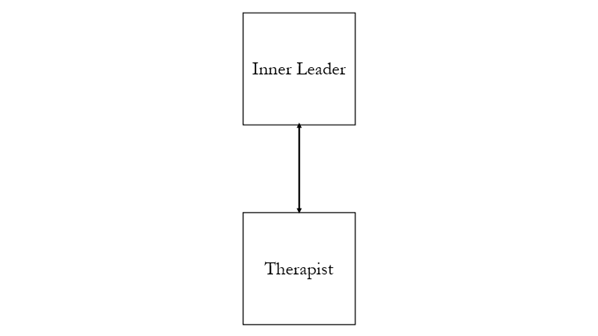
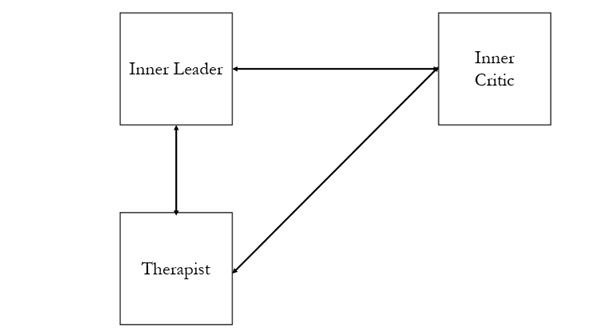
2. They start in Center or the Inner Leader Chair. (See Figure 1.) The therapist then invites them to move to another chair to embody the Critic. The therapist will begin to interview this part; this process is Giving Voice. (See Figure 2.)
3. The interview will seek to clarify the specific message that the Critic is sending. “What is it that you are trying to say to Harper?” “Why do you feel that it is so important to tell this to Harper?” “Plenty of people in the world have this kind of problem. Why do you care so much about Harper?” The goals are not only to clarify the essence of the message, but also to understand the intent of the Critic in expressing it. A socially acceptable explanation is not sufficient; the issue is why this specific Critic is concerned with this specific individual about this specific issue.
4. Further clarification: “Are you trying to help Harper or are you trying to hurt them?” “Are you a part of Harper or are you a voice from their past?” At this point, it is likely becoming clear as to whether this is an Internalized Abuser or a Protector Critic. If not, the therapist should continue to probe to get more details and more clarification. It is strategically very powerful and useful to say things like: “I do not understand. Would you explain that again?”
It is important to understand that you cannot diagnose which Inner Critic is present by the content of its messages; you can only diagnose it by clarifying its intentions.
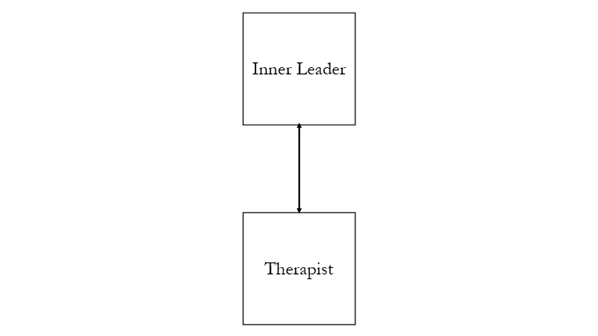
Figure 1
Therapist and Inner Leader Dialogue
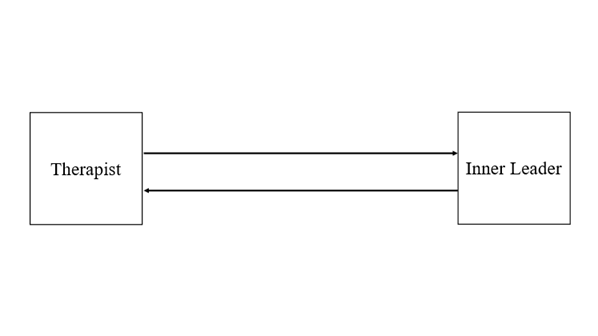
Note: The therapy begins with the therapist and the patient—in their Inner Leader mode—exploring their experience with their Inner Critic. This would include clarifying the kinds of messages that it sends, the level of pain and suffering that it is causing, and how it is impacting their life at the moment.
Figure 2.
Therapist Interviews the Inner Critic
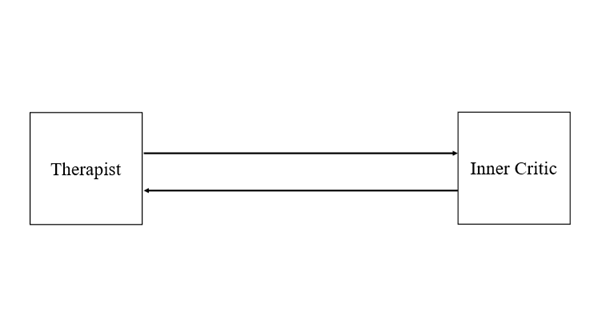
Note: The patient now moves to the Inner Critic Chair and is interviewed by the therapist. Using information that emerged when speaking with the Inner Leader, the therapist will strive to make a differential diagnosis; they will seek to discern whether this is an Internalized Abuser or a Protector Critic. A useful strategy is to keep the focus on what the Critic is doing and the reasons or intentions that it has for doing it rather than focusing on the behavior of the patient.
Working With the Internalized Abuser
Using a dialogical perspective, the Inner Critic is treated as if they were a person (Roediger et al., 2018). In this case, it can be exceptionally helpful to externalize the Internalized Abuser and see them as a person who now lives within the patient as an alien and destructive force. Again, the patient will move from the Center/Inner Leader Chair to the Inner Critic Chair. They will embody the Inner Critic while the therapist attacks them. (See Figure 3.)
Figure 3.
Therapist Confronts the Internalized Abuser
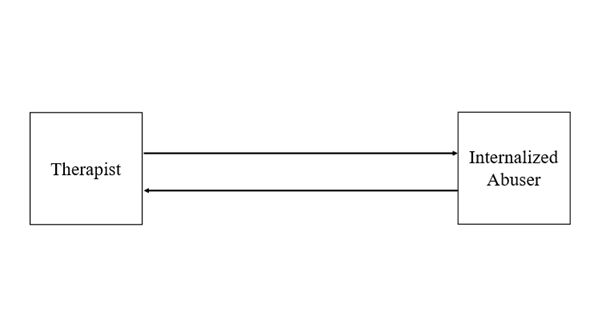
Note: Having now ascertained that this is an Internalized Abuser, the therapist harshly confronts and attacks this Critic for the terrible things that it has done and continues to do to the patient. The more intense the attack, the better.
For the therapist to effectively engage in a confrontation dialogue with the Internalized Abuser, it is generally best to focus on its behavior and impact rather than on specific criticisms: “You are so cruel.” “You are mean.” “You are hurting their spirit.” “You tell lies.” “You are definitely not on their side—and they should definitely not listen to you.” “You are evil!” If the Critic tries to get away from the confrontation—“I’m not going to speak with you then”—the therapist seeks to block this. “Now you are being a coward! You torment Harper all day long and now you are running away. It shows how pathetic you are. You are not good, you are not kind, and you are not to be listened to.” Each therapist can find their own way of doing this; however, intensity and seriousness—in whatever form—is vital to the success of the intervention.
The patient then moves back to the Inner Leader Chair where they process the experience with the therapist. (See Figure 1.) For many patients, the dialogue between the therapist and the Internalized Abuser is a shock. They have lived with this voice for years, decades, or a lifetime. They have often accepted these messages as true—despite the pain these messages caused them—and no one has ever stood up to the Critic, to this Internalized Abuser, in this or any way before. In the debrief, the therapist clearly identifies this voice as “evil”—as a voice that is focused on hurting and perhaps destroying the patient. The Internalized Abusers are quite damaging and they can even be dangerous[3].
In the next phase, the patient confronts the Internalized Abuser in the chair opposite. (See Figure 4.) This can include:
(a) Expressing anger and rage at the amount of pain that the Critic has caused them.
(b) Expressing anger and grief at how much has been taken from them and their lives by the Critic.
(c) Saying things like: “You are evil. You are trying to hurt me. You are a liar—the things that you say are not true. I reject you!”
The therapist should definitely use the Deepening Techniques. This kind of dialogue work can be very difficult and anxiety producing. Modeling the confrontation and providing language are central to the process.
Figure 4.
Inner Leader Confronts the Internalized Abuser
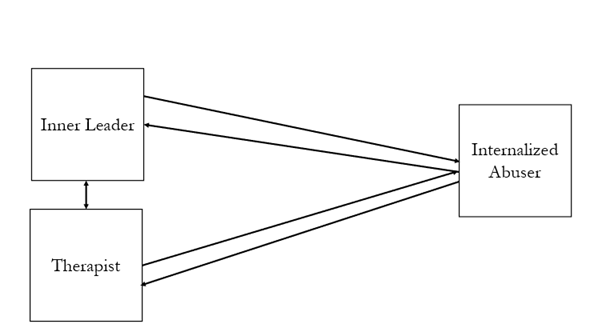
Note: Building on the attacks by the therapist and their own experience of suffering, the Inner Leader now attacks the Internalized Abuser. The therapist can also play a role by coaching the Inner Leader and by continuing the attack themselves. The patient can do a role reversal and give voice to the Critic if that will help to make the attacks more effective. The goal is for the Inner Leader to claim more power in its relationship with the Internalized Abuser.
Debrief
The therapist and the patient then process the experience. (See Figure 1.) It is important to affirm that it is likely that this voice will return—many times (Young et al., 2003). Nonetheless, the patient now knows who they are. They have externalized it, they are beginning to realize that it does not come with good intent, and they can now defend themselves and/or attack it when it re-appears. It may be necessary and important to repeat this dialogue numerous times in the therapy process—and that is fine and well. However, an intense first session can certainly be a profound experience.
Working With the Protector Critic
After having done the initial differential diagnosis and concluding that it is a Protector Critic, the dialogue would continue. Again, the patient has moved from Center/Inner Leader Chair and is now embodying the Protector Critic. (See Figure 5.) The therapist is now beginning to challenge the expertise and the admonitions of the Critic by attacking the lived experience of the Critic. A basic cross-examination approach might include these confrontational questions: “How many relationships have you been in?” “How many jobs have you had?” “How many times have you lost weight?” “How much money have you earned?” (The therapist can substitute the specific issue that the Critic is focusing on.) The only correct answer is “Zero.” “No, you have never done any of these things because you do not have a body! You have no lived experience! You are a part of their mind. You do not personally know what you are talking about!”
Doing this with enough force and emphasis may be sufficient to deflate a Protector Critic; if not, it is important to keep emphasizing these points until the therapist achieves a victory.
Figure 5.
Therapist Confronts the Protector Critic
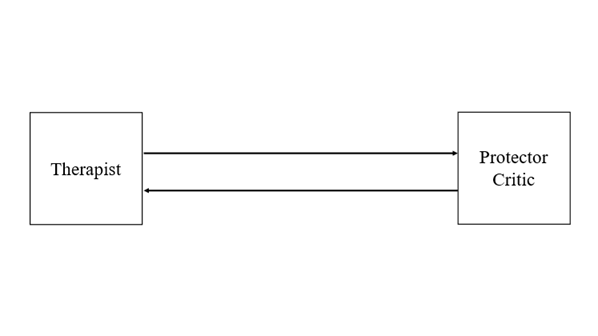
Note: The therapist, while acknowledging that the Protector Critic has been helpful at times, challenges its current role in the patient’s life. A central vehicle for this is both undermining its expertise— “You have no lived experience” —and pointing out that the goal is to strengthen the Inner Leader and that what the Protector Critic is doing is the exact opposite. In many cases, the Protector Critic will acknowledge this.
Resistance
If the Critic continues to resist the confrontation, there may be something important at work. It may be that the therapist and, perhaps, the patient, did not initially grasp the correct nature of the Critic. As was laid out above, if it is an Internalized Abuser, the Critic will be dismissive of the challenges and will hold onto the idea that they do not like the patient and/or that they are fat, etc.
Confrontation
The therapist then invites the patient to move back to the Inner Leader Chair and tell the Protector Critic what it has been like living under its influence. (See Figure 6.) Channeling the pain of the Suffering Part, the Inner Leader may say such things as: “I hate it. It is so painful.” “You constantly criticize me.” “I can’t do anything without worrying.” “Nothing is ever enough.” “I am constantly restraining myself.” “You never stop.” “You make me hate myself.”
The therapist then invites the patient to go back to the Protector Critic chair: “Please tell the Inner Leader what you just heard….and respond.” The patient is then invited to go back and forth between the two parts. The Inner Leader gets to speak with increasing anger and strength, and the Protector Critic begins to integrate the reality of its damaging impact on the patient. Through this process, the two begin to grow in relationship (Greenberg et al., 1993).
Understanding the developmental history of the Protector Critic is both important and meaningful. The patient is invited to move and embody the Protector Critic. The therapist then pursues this line of questioning: “How old was Harper when you came into their life?” “What was going on at the time?” “Why did you come in?” “What kinds of things did you do to keep them safe?” “How did it work out?” “How old is Harper right now?”
As was touched on earlier, the Protector Critic often emerges as a response to traumatic or stressful situations. When asked the current age of the patient, this part may respond with a younger age. This reflects the emotional or psychological reality of being “frozen” in a past traumatic period.
Figure 6.
Inner Leader Confronts the Protector Critic
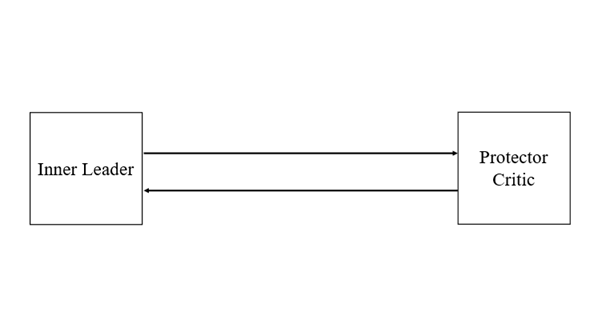
Note: Again, building on the work that the therapist did and their own suffering, the Inner Leader has a dialogue with the Inner Critic where they can review their relationship and the Inner Leader can express their sense that it is no longer working—and how it may not have been working for quite a while.
Moving back to the Inner Leader Chair, the Inner Leader can do something of a relational review with the Critic where it reviews how it was helpful and how it is now problematic. “After my stepfather moved in when I was six, the house was full of violence. I was so scared but you got me into sports and you kept telling me to work hard—and it was successful. That was my ticket out of the insanity. But it is too much now—it is way too much. I am a workaholic because of you.”
Rhombic Dialogue
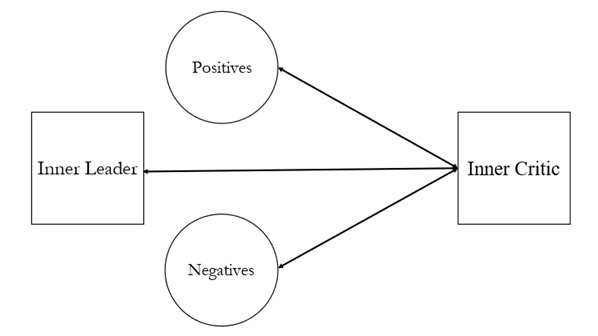
The Protector Critic is a complex figure as it has often been both helpful and problematic. Given that, a Rhombic Dialogue, which is a four-chair structure, may be helpful. As can be seen in Figure 7, there is a chair for the Inner Leader and a chair for the Protector Critic; there are also chairs on either side of the Inner Leader—one for the positive experiences with the Critic: “You got me through school and you saved my life”—and one for the negative experiences: “It is way too much. I am totally stressed out and I am starting to get physically ill from all the pressure that you are putting on me.” The patient speaks to the Critic while shuttling back and forth between the two chairs several times. They can then go to the Protector Critic Chair and share its perspective. At the end, they go back to the Inner Leader Chair and reflect on the experience and share their perspective.
Figure 7.
Inner Leader Explores Costs and Benefits with the Protector Critic
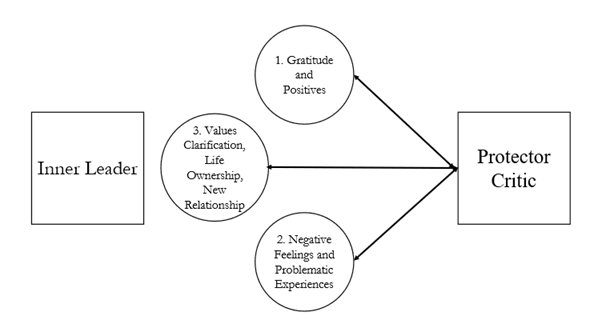
Note: Using this more advanced Chairwork dialogue structure, the Inner Leader can both express gratitude and distress about their relationship with the Protector Critic. Gratitude for how it helped in the past and even anger about how it is negatively impacting their life in the present. The goal is for the Inner Leader to begin to claim more power in the relationship.
Moving the Center of Gravity
The goal of these dialogues is for the Inner Leader to claim authority and lead a self-directed life. Here the Inner Leader says to the Protector Critic: “I am the Inner Leader and you are the Inner Critic. It is my life, not yours. I do not work for you!” This, or something like it, should be repeated several times so that the patient can say it with more strength and confidence. The therapist and the patient will also want to reflect on how it feels to claim one’s life and if this is triggering any anxiety that needs attention.
The patient is then invited to go to the Protector Critic chair and respond. The therapist then asks the Critic an important question: “Are you willing to trust the Inner Leader?” The Critic may balk at this; “I don’t feel comfortable doing that.” Moving back to the Inner Leader Chair, the therapist asks the Inner Leader: “Do you want to run your own life or do you want to keep working for the Inner Critic?” They almost always say that they want to run their lives. It is worth noting that some patients may say that they would rather that the Inner Critic tell them what to do. This is both meaningful and tragic, but at least the patient is deciding to live their life that way.
Joining the Team
The final stage is the Integration Stage. This is where the Inner Critic is asked by the therapist if it would be willing to be a part of “Team Harper” or “Team [Patient’s Name]”; if it would be willing to use their talents and skills to help Harper to become stronger and more successful. In short, to become an ally. These Critics often say “Yes”; if not, there may be a need for more exploration.
Moving back to the Inner Leader Chair, the therapist asks them if they are willing to have the Critic be a part of their team. A dialogue can then take place between the Inner Leader and the Inner Critic where they can sort things out.
For a script of a more extensive dialogue with the Protector Critic, please go to the Appendix at the end of the article or click here.
The Inner Critic and Historically Oppressed and Marginalized Communities
Working with patients from historically oppressed and marginalized communities adds another level of complexity to the treatment of Inner Critic issues; nonetheless, the strategies that have been presented are sufficient to bring healing to patients from these backgrounds. The differential diagnosis is key. There are several sources to be concerned about within the clinical setting. The first is that the larger society may have, overtly and covertly, conveyed messages of worthlessness, ugliness, and defectiveness that are now living within the patient as a form of internalized oppression (David, 2009). Of course, it may have been much more than words; there may be incidences of bullying or violence—both experienced and witnessed—that can be extremely damaging. Of note, these forms of oppression-centered mistreatment can also be experienced at the hands of other family members. The resulting negative voices can be treated as a manifestation of Internalized Abusers as these messages can be a highly crippling and destructive force in the lives of these individuals.
Subcultures and outside groups may develop their own survival strategies for coping with violence and hate. The result is that rules or injunctions about behavior are likely to be passed down to the next generation—in a process that is filled with high levels of fear and intensity. The children who internalized these prescriptions and proscriptions then begin to live and operate with a survival-based form of Protector Critic. Beyond this, individuals may develop Internalized Abuser and Protector Critics from their own experiences within their own family, subculture, or nonprejudicial encounters with the larger culture. The clinical implication of this is that the therapist working with patients from these groups will want to do in-depth explorations of the Critic messages as a way of ascertaining which combinations of these four types of Inner Critics may be activated in the patient (Cardoso et al., 2023; Garcia Torres, 2021, in press; Kellogg, 2015).
*******
Mary Pipher is a clinical psychologist and a writer. She spoke about her own struggles with depression in an interview with Tami Simon (Pipher & Simon, 2014):
“I am more comfortable talking about ‘despair’ than ‘depression’” (p. 35).
“most of us are our own tormentors and our own grand inquisitors, unless we deal with our own harsh inner critic, the inner hanging judge, we can’t heal from despair. Instead, we continue to inflict despair upon ourselves” (p. 39).
“For me, guilt is inside my despair. I tend to cut other people a lot of slack—but I don’t offer any to myself. I criticize myself for not being as polite and kind as I think I should be. So guilt has always been something I’ve had to work hard at overcoming” (p. 41).
*******
Compassion-Centered Chairwork
“In recent years, there has been a growing emphasis on creating positive and affirming internal parts and doing dialogues with these parts not only as a way of challenging the Inner Critic voice, but also as a way of bringing greater emotional regulation to the system. This includes working with the good or nurturing parent mode (Farrell & Shaw, 2018; Goulding & Goulding, 1997) and becoming your own best friend and speaking to yourself with ‘kindness, acceptance, and love’ (Leahy, 2010, p. 109)” (Kellogg & Garcia Torres, 2021, p. 176). In a related vein, Kellogg (2015; 2019b) was inspired by the Compassion Focused Therapy of Paul Gilbert (2010) and the Self-Compassion work of Kristin Neff (2011). Gilbert (2010) drew on a number of Buddhist sources in his understanding of compassion. Of note, he highlighted the Dalai Lama’s definition that compassion is “a sensitivity to the suffering of self and others with a deep commitment to try to relieve it” (p. 3).
The idea was to create a compassion-centered mode that would not only challenge the Inner Critic but also affirm the fundamental goodness of the individual. While other approaches might have sought to have the Inner Leader be compassionate to the parts, Kellogg felt that since the Inner Leader is already doing so much, it would be good to have another mode provide the voice of compassion so that all the parts—including the Inner Leader—would receive it. The result was a two-chair guided meditation that was anchored in Neff’s (2011) three components of compassion: (1) awareness of one’s suffering; (2) kindness to oneself; and (3) common humanity.
A Self-Compassion Mode Meditation[4]
“To begin, I invite the patient to do some self-compassion work with me. I tell them that I simply want them to repeat the words that I say. They do not have to reveal anything about themselves – I simply want them to repeat the words that I use. If they are willing to proceed, I set up two chairs that directly face each other and I ask the patient to sit in one chair and to take a minute or so to imagine themselves in the opposite chair. Sitting close to the chair in which the patient is sitting, I then ask the patient to repeat the words that I am saying. I say these words slowly and in short phrases. I pause so that they can repeat what I have said, and I will often repeat a phrase or say variations of the same phrase for greater emphasis” (Kellogg, 2019b).
“(Patient’s Name), I see you. [Patient Repeats]
(Patient’s Name), I see you. [Patient Repeats]
(Patient’s Name), I see you, and I know everything about you. [Patient Repeats]
I know every moment of darkness, every moment of ugliness, every moment of dishonesty. [Patient Repeats]
I know every moment of cruelty. [Patient Repeats]
I know every moment of shadow. [Patient Repeats]
I know every moment of kindness. [Patient Repeats]
I know every moment of caring. [Patient Repeats]
I know every moment of generosity. [Patient Repeats]
I know every moment of beauty. [Patient Repeats]
I know every moment of love. [Patient Repeats]
(Patient’s Name), I know every moment of courage, and I know every moment of light. [Patient Repeats]
I know everything about you, all the shadow and all of the light. [Patient Repeats]
And knowing everything about you, (Patient’s Name), I respect you, I admire you, and I love you. [Patient Repeats]
Knowing everything about you, I respect you, I admire you, and I love you. [Patient Repeats]
[Long Pause]
(Patient’s Name), when I look at your life, I see that you have gone through great suffering, that there has been great pain, that there has been great difficulty in your life. [Patient Repeats]
And I see that you have suffered a great deal. [Patient Repeats]
And when I see the pain that you have been through, I feel distressed. [Patient Repeats]
When I see the pain that you have been through, I feel distressed. [Patient Repeats]
When I see the pain that you have been through, I feel anguish. [Patient Repeats]
But I also know that you are not destroyed by this suffering, that you are not destroyed by this pain, that you survived this pain, in some cases you even thrived in the face of it. [Patient Repeats]
And I think that is amazing, and I think that is wonderful. [Patient Repeats]
And I am happy to see that you were able to do that. [Patient Repeats]
[Long Pause]
(Patient’s Name), there is something else that I see. [Patient Repeats]
I see that when you make a mistake, that when you do something wrong, that when you fail, I see that you are cruel to yourself and that you are brutal to yourself. [Patient Repeats]
(Patient’s Name), I see that when you fail, that when you make a mistake, when things don’t work out, you are harsh and cruel with yourself. [Patient Repeats]
And when I see the way you treat yourself, I am horrified. [Patient Repeats]
I am horrified when I see you treat yourself with such cruelty and such brutality. [Patient Repeats]
[Long Pause]
And (Patient’s Name), there is something I want to tell you, and I want you to pay attention. [Patient Repeats]
(Patient’s Name), there is something I want to tell you, and I want you to pay attention. [Patient Repeats]
(Patient’s Name), I want you to listen to me. [Patient Repeats]
This is important, and I want you to pay attention. [Patient Repeats]
(Patient’s Name), all people make mistakes. [Patient Repeats]
All people make mistakes, (Patient’s Name),. [Patient Repeats]
All people do things they later wish they had not done, and all people fail to do things that they later wish they had done. [Patient Repeats]
All people have regrets. [Patient Repeats]
All people have remorse. [Patient Repeats]
All people make mistakes. [Patient Repeats]
(Patient’s Name), you have made mistakes. [Patient Repeats]
(Patient’s Name), you have failed. [Patient Repeats]
You have regrets, and you have remorse. [Patient Repeats]
But you are not alone. [Patient Repeats]
(Patient’s Name), you are like all the other people in this world. [Patient Repeats]
They have failed, and you have failed. [Patient Repeats]
You have regrets and they have regrets; you have remorse and they have remorse. [Patient Repeats]
You are not alone. [Patient Repeats]
You are just like them. [Patient Repeats]
You are just like millions and billions of other people on this planet. [Patient Repeats]
You are just like all the other human beings. [Patient Repeats]
You are not alone. [Patient Repeats]
[Long Pause]
And I also see, when I look at you, that you are far more than your mistakes. [Patient Repeats]
(Patient’s Name), you are far more than your failures and your errors. [Patient Repeats]
When I look at you, (Patient’s Name), I see that there are amazing things inside of you. [Patient Repeats]
There are wonderful things inside of you, and that fills me with joy. [Patient Repeats]
When I see the amazing things inside of you, that fills me with joy. [Patient Repeats]
[Long Pause]
In the hours and days ahead, (Patient’s Name), there will be many voices in your mind. [Patient Repeats]
In the hours and days ahead, there will be many voices in your mind. [Patient Repeats]
My voice will be there. [Patient Repeats]
Listen for my voice. [Patient Repeats]
My voice will be there. [Patient Repeats]
Listen for my voice. [Patient Repeats]
And together we will walk into the future one step at a time. [Patient Repeats]”
I then ask the patient to switch chairs and to sit in the chair that they were talking to. I then say to them, “I would like you to close your eyes and see if you can take in any of the things that you just said to yourself. If you can take in a little bit, that is fine. If you can take in more, that is fine. If you cannot take in any of it, that is fine as well. To whatever degree that you are able or willing to, I would like you to open yourself up to those words of self-compassion.” I then allow the patient to sit there with his or her eyes closed for a minute or two. I then say, “When you are ready, I would like you to slowly open your eyes and come back to the room.” I then ask them if they were able to take in any of that and what the experience was like. After that, we can move the chairs and debrief the experience.
Concluding Thoughts
When listening to patients and reading the writings of or about people whose lives were plagued or severely damaged by the presence of an Inner Critic, the importance of therapists engaging with and vigorously confronting their patients’ Inner Critics while affirming their goodness seems paramount. There is some tradition of doing this. Perls (1969a) created “Top Dog-Bottom Dog” Chairwork dialogue in the 1960s. The Gouldings (1997), in their Redecision Therapy, used Chairwork to challenge the internalized messages of abusers, and Jeffrey Young, in his Schema Therapy (Young et al., 2003), directly confronted Inner Critic forces in the patient. Nonetheless, this practice remains more the exception than the rule. It is our hope that this paper will inspire clinicians to take on the challenge of fighting for their patients’ lives in this fierce, beautiful, and dramatic way.
References
Anderson, W. T. (1983). The upstart spring: Esalen and the American awakening. Addison-Wesley Publishing Company.
Arntz, A., & van Genderen, H. (2009). Schema therapy for borderline personality disorder. Wiley-Blackwell.
Baumgardner, P. (1975). Gifts from Lake Cowichan. Science and Behavior Books.
Beisser, A. (1970). The paradoxical theory of change. In J. Fagan & I. L. Shepherd (Eds.),
Gestalt Therapy now: Theory, techniques, applications (pp. 77–80). Science and Behavior Books.
Callahan, J. F. (2014). Manual of gestalt therapy in the tradition of Dick Price (Rev. ed.). Gestalt Legacy Project.
Chesner, A. (2019). Working with addictions: The addictions compass and intergenerational action genogram. In A. Chesner (Ed.), One-to-one psychodrama psychotherapy: Applications and technique (pp. 68–79). Routledge. https://doi.org/10.4324/9780203728765-6
Cardoso, B. L. A., Paim, K., Catelan, R. F., & Liebross, E. H. (2023). Minority stress and theinner critic/oppressive sociocultural schema mode among sexual and gender minorities. Current Psychology, 42(23), 19991–19999. https://doi.org/10.1007/s12144-022-03086-y
David, E. J. R. (2009). Internalized oppression, psychopathology, and cognitive-behavioral therapy among historically oppressed groups. Journal of Psychological Practice, 15, 71–103.
Daniels, V. (2005). The method of “shuttling” in the Gestalt working process. Gestalt! 9.
Dayton, T. (2005). The living stage: A step-by-step guide to psychodrama, sociometry and experiential group therapy. Health Communications.
de Oliveira, I. R. (2016). Trial-based cognitive therapy: Distinctive features. Routledge.
Earley, J. (2016). Embracing all our parts. In T. Simon (Ed.), The self-acceptance project: How to be kind and compassionate toward yourself in any situation (pp. 39–45). Sounds True.
Elliott, J., & Elliott, K. (2000). Disarming your inner critic. Anthetics Institute Press.
Fagan, J., & Shepherd, I. L. (1970). Gestalt therapy now: Theory, techniques, applications. Science & Behavior Books.
Farrell, J. M., & Shaw, I. A. (2018). Experiencing schema therapy from the inside out: A self-practice/self-reflection workbook for therapists. Guilford Press.
Firestone, L. (2010, November 10). The critical inner voice that causes depression. PsychAlive. https://www.psychalive.org/the-critical-inner-voice-that-causes-depression/
Firestone, L., & Catlett, J. (1998). The treatment of Sylvia Plath. Death Studies, 22, 667–692.
Garcia Torres, A. (2021, March). Using chairwork psychotherapy to combat the psychological impact of oppression. Schema Therapy Bulletin, 21, 4–11. https://transformationalchairwork.com/wp-content/uploads/2021/09/Garcia-Torres-ISST-Social-Justice-Chairwork-Psychotherapy.pdf
Garcia Torres, A. (in press). Creating freedom in the here and now: Using chairwork to combat the psychological impact of oppression in LGBTQIA+ individuals. In N. Manktelow, B. L. A. Cardoso, & J. Camp (Eds.), Handbook of schema therapy for LGBTQIA+communities: A culturally sensitive approach. Springer.
Gilbert, P. (2010). Compassion focused therapy. Routledge.
Goulding, M. M., & Goulding, R. (1997). Changing lives through redecision therapy. Grove Press.
Greenberg, L. S., Rice, L. N., & Elliott, R. (1993). Facilitating emotional change: The moment-by-moment process. Guilford Press.
Harris, T. A. (1969). I’m OK—you’re OK: A practical guide to Transactional Analysis. Galahad Books.
Hayes, S. C. (2016). Perspective-taking as healing. In T. Simon (Ed.), The self-acceptance project: How to be kind and compassionate toward yourself in any situation (pp. 29–38). Sounds True.
Kellerman, P. F., & Hudgins, M. K. (2000). Psychodrama with trauma survivors: Acting out your pain. Jessica Kingsley.
Kellogg, S. H. (2004). Dialogical encounters: Contemporary perspectives on “chairwork” in psychotherapy. Psychotherapy: Research, Theory, Practice, Training, 41(3), 310–320. https://doi.org/10.1037/0033-3204.41.3.310
Kellogg, S. (2015). Transformational chairwork: Using psychotherapeutic dialogues in clinical practice. Rowman & Littlefield.
Kellogg, S. (2018, July). Transformational chairwork: The four-dialogue matrix. Schema Therapy Bulletin. http://transformationalchairwork.com/wp-content/uploads/2018/07/Kellogg-TCW-Four-Dialogue-Matrix-ISST-Bulletin1.pdf
Kellogg, S. (2019a, October). Transformational chairwork: Therapeutic change using the four dialogues. InPsych: The Bulletin of the Australian Psychological Society Limited, 41(5), 16–21. https://www.psychology.org.au/for-members/publications/inpsych/2019/october/Transformational-chairwork
Kellogg, S. (2019b, December). When I think of your suffering, I feel…: On dialogues and self-compassion in schema therapy. Schema Therapy Bulletin, 15–19. https://transformationalchairwork.com/when-i-think-of-your-suffering-i-feel-on-dialogues-and-self-compassion-in-schema-therapy/
Kellogg, S. (2020, February 22). Working with the four dialogues: Using chairwork in clinical practice. Mad in America. https://www.madinamerica.com/2020/02/four-dialogues-chairwork/
Kellogg, S., & Garcia Torres, A. (2021). Toward a chairwork psychotherapy: Using the four dialogues for healing and transformation. Practice Innovations, 6(3), 171–180.https://doi.org/10.1037/pri0000149
Kellogg, S. H., & Tatarsky, A. (2012). Re-envisioning addiction treatment: A 6-point plan. Alcoholism Treatment Quarterly, 30(1), 109–128.https://www.tandfonline.com/doi/abs/10.1080/07347324.2012.635544
Kellogg, S., Trapp, R., & Rizzon, A. (2023). Bringing it to life: Using chairwork and the four dialogues in schema therapy. Chairwork Psychotherapy Initiative. https://www.chairworkpsychotherapy.com/chairworkschematherapy
Kellogg, S. H., & Young, J. E. (2006). Schema therapy for borderline personality disorder. Journal of Clinical Psychology, 62(4), 445–458. https://doi.org/10.1002/jclp.20240
Lacy, E. (2024, July 1). STAT: Schema Therapy for addiction treatment, a proposal for the integrative treatment of addictive disorders. Frontiers in Psychology, 15. https://doi.org/10.3389/fpsyg.2024.1366617
Leahy, R. L. (2010). Beat the blues before they beat you: How to overcome depression. Hay House.
Maté, G. (2010). In the realm of hungry ghosts. North Atlantic Books.
Moreno, J. (2019). Psychodrama. Psychodrama Press.
Moreno, Z. T. (2012). To dream again: A memoir. Mental Health Resources.
Perls, F. S. (1969a). Gestalt therapy verbatim. Real People Press.
Perls, F. S. (1969b). In and out the garbage pail. Bantam Books.
Pipher, M., & Simon, T. (2014). Despair cracks open our hearts: An interview with Mary Pipher, PhD. In T. Simon (Ed.), Darkness before dawn: Redefining the journey through depression (pp. 35–44). Sounds True.
Plath, S. (2000). The unabridged journals of Sylvia Plath, 1950–1962 (K. V. Kukil, Ed.). Anchor Books.
Polster, M. (1987). Gestalt therapy: Evolution and application. In J. Zeig (Ed.), The evolution of psychotherapy (pp. 312–322). Brunner/Mazel.
Rafaeli, E., Bernstein, D. P., & Young, J. (2011). Schema therapy: Distinctive features. Routledge.
Roediger, E., Stevens, B., & Brockman, R. (2018). Contextual schema therapy: An integrative approach to personality disorders, emotional dysregulation & interpersonal functioning. Context Press.
Rowan, J. (1990). Subpersonalities: The people inside us. Routledge.
Russell, B. (1956). Alfred North Whitehead. In Portraits from memory and other essays (pp. 99–104). Simon and Schuster.
Simon, T. (2016). Introduction. In T. Simon (Ed.), The self-acceptance project: How to be kind and compassionate toward yourself in any situation (pp. ix–xii). Sounds True.
Stone, H., & Stone, S. (1989). Embracing our selves: The voice dialogue manual. New World Library.
Welwood, J. (1996). Depression as a loss of heart: Opening to healing through inner work. In J. E. Nelson & A. Nelson (Eds.), Sacred sorrows: Embracing and transforming depression (pp. 160–167). Jeremy P. Tarcher/Putnam.
Young, J. E., Klosko, J. S., & Weishaar, M. E. (2003). Schema therapy: A practitioner’s guide. Guilford Press.
Author Note
Scott Kellogg: https://orcid.org/0000-0003-0556-3294
Amanda Garcia Torres: https://orcid.org/0009-0001-4799-6437
Correspondence concerning this article should be sent to Scott Kellogg, Chairwork Psychotherapy Initiative, Email: info@chairworkpsychotherapy.com
Funding Statement: The authors received no funding for the preparation of this manuscript.
Disclosure of Interest: The authors report no conflicts of interest.
This paper was adapted, in part, from an unpublished manuscript by Kellogg & Garcia Torres, Fighting for a future: Using chairwork psychotherapy with trauma, self-hatred, and addiction.
Image: iStock/Queek
[1] We will use the terms parts, modes, voices, or selves interchangeably. In the context of this paper, they all refer to the same thing.
[2] (Whenever we are referring to an imaginary patient of our own creation, we will call them Harper. In the places where other clinical material is used, the name provided by the author is used.)
[3] At the 1985 Evolution of Psychotherapy Conference, Miriam Polster, the Gestalt Therapist, and Robert Goulding, the creator of Redecision Therapy, had an important dialogue. Miriam Polster, taking a West Coast Gestalt approach, argued that the integration of all of the parts is one of the major goals of psychotherapy. Robert Goulding, taking what might be seen as an Internalized Abuser stance, strongly disagreed. He said: “For instance, a suicidal client is dealing with some of the early messages that he got from his parents where he experiences one of his parents as being angry with a scowling face. When he’s sitting in the other chair, he’s being that parent saying, ‘I wish you were dead. I wish you’d never been born!’. . . I don’t know how to integrate that part of the parent that is so scowling, murderous, disruptive. I teach my people to say goodbye to that part” (Robert Goulding in M. Polster, 1987, p. 323).
[4] This is a basic script for self-compassion. Clinicians should feel free to change and adapt this dialogue work to fit the specific needs, challenges, and histories of their patients.
Appendix
Working With The Inner Critic: A Chairwork Dialogue
Working With The Inner Critic: A Chairwork Dialogue
This is a fictitious dialogue that was inspired by a scenario that Robert and Mary Goulding described in their book, Redecision Therapy[1]
Therapist: Chad, I know that you spoke about how tired you are and how much you are working. I was wondering if that was something that you wanted to focus on today—or if you had something else in mind.
Chad: No. That has definitely been on my mind all week. I want to talk about it.
Therapist: What is going on?
Chad: All I do is work. I have been doing this for a long time. Even when I am not working, I feel like there is a part of me that keeps telling me that I need to be doing something.
Therapist: More specifically, how is this a problem for you?
Chad: I am tired. I don’t sleep well. My body hurts. My wife is angry at me all the time for not being available for her or the family. I am having trouble finding time to work out.
Therapist: Anything else?
Chad: To be honest, I don’t think that I am as creative as I want to be, as I need to be—even though I am working all these hours. You know, I have been like this for a long time, but now I feel like it is catching up to me.
Therapist: So, this is a problem that you want to work on?
Chad: Yes.
Therapist: You said before that you feel like there is a part of you that wants you to keep working?
Chad: Yes.
Therapist: Can you tell me about that?
Chad: It is like this voice or this presence that keeps pushing me—telling me to do more.
Therapist: Okay. Maybe I can work with this?
Chad: Yes.
Dialogue with the Inner Critic
Therapist: I would like you to move to this chair.
[Chad gets up and moves to the Inner Leader Chair.]
Now I want to give you some words and I would like you to repeat them.
Chad as the Inner Leader: Okay.
Therapist: I am Chad. I am the Inner Leader – and this is my life.
Chad as the Inner Leader: I am Chad. I am the Inner Leader – and this is my life.
Therapist: I am Chad. I am the Inner Leader – and this is my life.
Chad as the Inner Leader: I am Chad. I am the Inner Leader – and this is my life.
Therapist: I am Chad. I am the Inner Leader and I have many parts.
Chad as the Inner Leader: I am Chad. I am the Inner Leader and I have many parts.
Therapist: These parts have their histories. These parts have their roles.
Chad as the Inner Leader: These parts have their histories and these parts have their roles.
Therapist: These parts have their functions.
Chad as the Inner Leader: These parts have their functions.
Therapist: Many of these parts have good intentions.
Chad as the Inner Leader: Many of these parts have good intentions.
Therapist: Some of these parts do not have good intentions.
Chad as the Inner Leader: Some of these parts… Some of these parts do not have good intentions?
Therapist: Yes. Some of these parts do not have good intentions.
Chad as the Inner Leader: Okay. Some of these parts do not have good intentions.
Therapist: I am Chad. I am the Inner Leader, and this is my life.
Chad as the Inner Leader: Yes. I am Chad. I am the Inner Leader, and this is my life.
Therapist: I have many parts. These parts are important.
Chad as the Inner Leader: I have many parts. These parts are important.
Therapist: However, it is my life—it is not their life.
Chad as the Inner Leader: Yes. It is my life – it is not their life.
Therapist: Say that again.
Chad as the Inner Leader: It is my life – it is not their life.
Therapist: Again.
Chad as the Inner Leader: It is my life – it is not their life.
Therapist: I am Chad and I am the Inner Leader!
Chad as the Inner Leader: I am Chad and I am the Inner Leader! And This Is My Life!
Therapist: Good. This voice that is inside of you. I call this an Inner Critic.
Chad as the Inner Leader: Yes. Definitely. It is relentless
Therapist: I would like to speak with this part of you. Is that okay?
Chad as the Inner Leader: Yes.
Therapist: I would like you to move to this chair and become the Inner Critic.
[Chad moves to the Inner Critic Chair.]
Take a moment to see if you can find the Inner Critic within you and see if you can bring it up. [Pause] Let me know when it is there.
Chad as the Inner Critic: [Pause] Okay. It is here.
Therapist: Inner Critic—may I speak with you?
Chad as the Inner Critic: Yes.
Therapist: Chad said that you are kind of on him all the time to keep working. What is that about?
Chad as the Inner Critic: Yes. I am on him. He won’t be successful if he is not working and he won’t make enough money if he is not working.
Therapist: So you believe that the more he works, the more successful he will be, and the more money he will have?
Chad as the Inner Critic: Yes.
Therapist: So, would it be fair to say that even though you are on him all the time about this, you are trying to help him?
Chad as the Inner Critic: Yes. Definitely.
Therapist: You seem a bit anxious about all of this.
Chad as the Inner Critic: Yes. I am. I feel like if he is not working, Something bad could happen. He could lose everything.
Therapist: Are you a new part of him or have you been here for a long time?
Chad as the Inner Critic: I have been with him for a long time.
Therapist: How old was he when you first came into his life?
Chad as the Inner Critic: He was about six or seven at the time.
Therapist: What was going on at the time that you felt that it was important to come into his life?
Chad as the Inner Critic: His father lost his job and this was a financial disaster. It went on for a year or so. Chad’s family actually lost their house. His father was beside himself with anxiety about money. From that point on, he would often talk to Chad about how important it was to have money—that you needed to be prepared—and having a lot of money would help you be safe.
Therapist: Did the family ever recover?
Chad as the Inner Critic: They actually did but it took a long time for them to get back on their feet—years. They did it, but it was traumatic. It was traumatic for Chad, for his mother, and for his siblings.
Therapist: Where do you fit in this story?
Chad as the Inner Critic: I came in and basically said: “If we work hard, this won’t happen again. We will be safe.” And I have been getting Chad to work hard ever since.
Therapist: So, you came it to keep him safe?
Chad as the Inner Critic: Definitely.
Therapist: It sounds like you did something good here.
Chad as the Inner Critic: Yes. Thank you.
Therapist: Now I would like you to come back to this chair and be the Inner Leader again.
[Chad gets up and moves back to the Inner Leader Chair.]
So, what do you make of all of this?
Chad as the Inner Leader: That feels right. I remember that time very well. It was awful. My father was so upset. He would walk around the house angry. I even remember his crying sometimes. We were all afraid.
When we lost that house, that was terrible. My parents had worked so hard to get it. It was a dream for them. My Dad did pull it together later, and we did get another house. My mother used to talk about that first house sometimes; I am not sure that she ever fully got over the loss.
Therapist: It sounds terrible.
Chad as the Inner Leader: Yes.
Therapist: How did the Critic play a role in your life after this?
Chad as the Inner Leader: I began to work very hard in school. I had this idea that if I worked hard somehow everything would be safe, I would be safe.
Therapist: So, there were some benefits to what the Critic was doing?
Chad as the Inner Leader: Yes.
Therapist: Can you tell me more about that?
Chad as the Inner Leader: Yes. I was driven. I was able to get into a specialized high school and a good college. It got me through graduate school, and it helped me start my own business. So much of what I have is because the Critic has been there—relentlessly pushing.
Therapist: And the downsides?
Chad as the Inner Leader: I am exhausted. It seems to be pushing me even more. I am starting to get some health problems. My blood pressure is up a bit. I am not getting to the gym as much. I am anxious all the time. My wife is angry at me; she says that I am constantly on my phone and that I am not there for her or the kids. I just feel burnt out.
Therapist: Okay. I want to set this dialogue up a bit differently. [The Therapist brings over two more chairs. He puts them on either side of the Inner Leader Chair – facing the Inner Critic Chair.]
One of these chairs represents the positives of what the Inner Critic has done for you and one of them represents the negatives. Which one do you want to be which?
Chad as the Inner Leader: The one on the Left can be the positives and the one on the Right can be the negatives.
Therapist: Good. I want you to stand behind the middle chair and I want you to look at the Inner Critic. Can you see him or imagine his presence?
Chad as the Inner Leader: (Pauses) Yes. I can see him there.
Therapist: I would like you to say this: “I am Chad. I am the Inner Leader, and this is my life.”
Chad as the Inner Leader: I am Chad. I am the Inner Leader and this is my life.
Therapist: Good. Now, you said that the chair on the right represents the positives or the benefits of what the Critic has done for you and the chair on the left are the costs or the downsides. I would like you to move to either of these chairs and speak to the Critic from that perspective.
Chad as the Inner Leader: (Chad moves to the chair on the right side.) Critic, you have helped me a lot. You saved my life, really. You got me through school and grad school. When others were fooling around, you kept me focused. You helped me start this company and you have helped me make it a success. I have been able to take care of the family because of this. I do not think that I could have done this without you. (Pauses.)
Therapist: Now move to the chair on the left.
Chad as the Inner Leader: (Chad moves to the chair on the left.) You are killing me. This is way too much. I am exhausted. I go to the office and I sit at my desk and I can’t even work. Silvia is angry at me all the time; she feels that I am not there – even when I am there. The boys are upset. They have a father who is never around. I am stressed and burned out. I am getting sick. It is not working.
Therapist: Go back to the other chair and speak from there.
Chad as the Inner Leader: You have given me So much. We have a good home. There is money for the family. You got me through those difficult times. Again, I do not know where I would be without you.
Therapist: Back to the other chair.
Chad as the Inner Leader: I am tired and I am lonely. The family is angry at me, and I have no friends. This can’t go on.
Therapist: Start shuttling back and forth between the two chairs – saying one or two things on each side.
Chad as the Inner Leader: (Goes to the chair on the right.) Thank you. You made my life possible. You helped me succeed.
Therapist: Switch.
Chad as the Inner Leader: (Goes to the chair on the left.) This can’t go on. I have reached my limit. I have reached the end.
Therapist: Switch and just go at your own pace.
Chad as the Inner Leader: (Right chair.) How can I stop? There are So many people relying on me.
(Left chair.) This is like a house of cards. It is all going to fall down if I don’t do something. Silvia is not going to put up with this forever.
(Right chair.) I can’t stop running this race. We have created So much. If we don’t stay with it, we will lose it.
(Left chair.) I am starting to lose my family. I am starting to lose my life.
Therapist: Come to the center and look at the Inner Critic. Tell him what that felt like. Tell him where you are with things right now?
Chad as the Inner Leader: (Long pause.) That was intense.
Therapist: Talk to him directly.
Chad as the Inner Leader: Critic. I really felt both sides. I felt how much you had helped me; how amazing it is that we have what we have today. I alSo felt that I am at the end of the road and that this cannot go on any longer. (Long Pause)
Therapist: Chad. I would like you to go over there and sit in the Critic chair. I would like you to become the Critic again. (Chad moves and stands behind the Critic Chair.)
Critic. What do you make of all of this?
Chad as the Inner Critic: I don’t know exactly. I have been trying to help him. I’ve been trying to keep him safe.
Therapist: Yes. I know that. In many ways you have done a great job; you really helped him. But I don’t think that it is working any more. What do you think?
Chad as the Inner Critic: From what he is saying, it So unds like that.
Therapist: I get a sense that you believe that the more he works, the safer he will be and the more success that he will have.
Chad as the Inner Critic: Yes, exactly.
Therapist: The science teaches us something different. When they study the lives of the most successful entrepreneurs, athletes, and artists, they find that they alternate between periods of deep and intense work and deep relaxation, rest, and recovery[2]. What you are prescribing here is actually a recipe for failure.
Chad as the Inner Critic: I find that hard to believe.
Therapist: I spend a lot of time talking with Critics; they often have trouble with that idea.
I want to ask you a question: how many companies have you created?
Chad as the Inner Critic: Well, I have created the one he has right now.
Therapist: No, you have not done that.
Chad as the Inner Critic: What do you mean?
Therapist: You do not have a body. You are only a part of Chad’s mind. You have not created anything. How many exams have you taken and passed.
Chad as the Inner Critic: I took many when he was in school – especially in Grad school – I took some difficult ones.
Therapist: No, you didn’t. You have never taken any exams. You have never had a job. You have never built a company. You have never been in a relationship or raised a family. You have never done any of these things. You are not a perSo n. You are a part of his mind.
Chad as the Inner Critic: Okay. I see what you are driving at.
Therapist: You have no lived experience which means that you do not know what you are talking about!
Chad as the Inner Critic: Now you are making me feel bad.
Therapist: It doesn’t mean that you have nothing to offer, but it does mean that you should not be running Chad’s life.
Chad as the Inner Critic: I am going to have to think about this.
Therapist: Chad – please move back to the Inner Leader Chair. (Chad moves back to the Inner Leader Chair. ) Again, please say: I am Chad. I am the Inner Leader, and this is my life.
Chad as the Inner Leader: I am Chad. I am the Inner Leader, and this is my life.
Therapist: Do you want to keep working for the Inner Critic or do you want to take charge of your life?
Chad as the Inner Leader: I want to take charge of my life.
Therapist: Are you sure? You do not have to. You can continue to work for him.
Chad as the Inner Leader: No. I do not want to keep doing this – it is killing me.
Therapist: Tell him: This is my life. I do not work for you.
Chad as the Inner Leader: (Looking at the Inner Critic Chair.) This is my life. I do not work for you.
Therapist: Again.
Chad as the Inner Leader: This is my life. I do not work for you.
Therapist: Again.
Chad as the Inner Leader: This is my life. I do not work for you.
Therapist: Again. Louder.
Chad as the Inner Leader: This is my life! I do not work for you! (Pause.)
Therapist: How are you feeling?
Chad as the Inner Leader: Much stronger.
Therapist: Good. (Very long pause.)
I would like you to be the Inner Critic again. (Chad moves back to the Inner Critic Chair.)
Critic, I would like to talk to you about something.
Chad as the Inner Critic: Okay.
Therapist: I was thinking that you cannot be running things – that is not working. I was wondering if you would be willing to use your talents and your insights to support Chad? Not to tell him what to do but to support him.
Chad as the Inner Critic: What do you mean?
Therapist: I am wondering if you would be willing to be a kind of ally, to be a So urce of support as he goes forward?
Chad as the Inner Critic: That would be good. I was afraid that you were going to try to get rid of me.
Therapist: No. I don’t want to get rid of you. I think you might have something to offer. But you need to be in a very different role.
Chad as the Inner Critic: Okay. I would be happy to do that.
Therapist: Would you move back and become the Inner Leader? (Chad moves back to the Inner Leader Chair.) So , what do you think? Would you be willing to have the Critic become an ally?
Chad as the Inner Leader: Yes. That would be good. Will he be able to stay in that role?
Therapist: He will probably have some slip ups for a while, but now that you have done this work, you can always remind him that you do not work for him and that this is your life.
Chad as the Inner Leader: Okay. Yes. I can do that.
Therapist: Very good.
Debrief
(Chad and the Therapist rearrange their seats So they are now facing each other.)
Therapist: So, what do you make of that? How are you feeling?
Chad: That was intense. I am feeling better. I am feeling lighter, actually.
Therapist: Good.
Chad: There is a question that keeps coming up in my mind.
Therapist: Yes.
Chad: What do I do? If I stop listening to him, how do I run my company successfully? What do I do about my family?
Therapist: The therapeutic goal here is that your Inner Leader gets stronger. You can actually keep working the way that you are working right now, if you wish. Or you can make small changes – or big changes. What is important is which part is in charge of the situation.[3] If you are running things as the Inner Leader, it means that you are not working for anybody else – at least internally. That is a dramatically different situation from having the Inner Critic as your boss.
Chad: Okay. Yes, I can see that. That makes a lot of sense.
Therapist: Anything else?
Chad: No. I’m good. Thank you for that.
Therapist: Thank you. That was not easy to do. It took some courage. See you next week.
[1] Goulding, M. M., & Goulding, R. (1997). Changing lives through redecision therapy. Grove Press.
[2] Sharma, R. (2018). The five o’clock club, Own your morning. Elevate your life. HarperCollins.
[3] Stone, H., & Stone, S. (1989). Embracing our selves. New World Library.